
Halfmoon City Directory Collections
There is no documented, dedicated printed Halfmoon city-directory run. The useful shelf is regional instead: the Town Clerk’s historical inventory, Saratoga County directories, Saratoga Springs city volumes, telephone books, and the research collections at Clifton Park, Brookside, and the county historian. That geography matters. A rural address may be filed under a hamlet or post office, and a Saratoga Springs volume is not a complete Halfmoon resident list. Treat each as evidence for a date, address, occupation, or postal connection, then confirm it with another record.
| Collection | Years | Where held | Access |
|---|---|---|---|
| Halfmoon town census | 1790-1850 | Town Clerk historical inventory | Ask the clerk or historian |
| Saratoga County directory | 1870/71 and 1890 | New York State Library microfilm | Non-circulating, on site |
| Saratoga Springs city directories | 1872-1944 and 1946 | New York State Library microfilm | Non-circulating, on site |
| Saratoga Springs telephone books | 1922; 1940-1942; 1945-1947; 1949-1950 | New York State Library | On-site microforms |
| Pre-Shenendehowa school records | Mostly 1910-1961 | Clifton Park-Halfmoon Public Library | Local-history research |
For a source view, see the New York State Library directory holdings. Its city directories, telephone books, and county directories are non-circulating, so the practical fallback is an in-person microforms visit rather than an assumed online name search.
Halfmoon City Directory Research Desk
The Ed & Francine Rodger Local History Room at Clifton Park-Halfmoon Public Library is the best first stop for a Halfmoon city directory question that needs local context. The library holds published genealogies, books about Halfmoon and Saratoga County, cemetery compilations, early-road and school material, local clippings, maps, census microfilm, and American Baptist church microfilm. Its history files cover Clifton Park and Halfmoon, which helps when a resident or street crosses the older town geography.
The library is at 475 Moe Road in Clifton Park and posts Monday through Thursday hours of 9 a.m. to 9 p.m., Friday 9 a.m. to 6 p.m., Saturday 9 a.m. to 5 p.m., and Sunday noon to 5 p.m. Before a visit, bring the surname, a likely year, an address or hamlet, and any spelling variant. Its local-history research page is the appropriate starting link. A staff member can point to a shelf, microfilm set, map, or related collection even when no volume carries “Halfmoon” on the cover.
Note: Search the postal city and the legal town separately because Halfmoon residents can be indexed under regional labels.
Halfmoon City Directory Year Runs
The nearest deep run is the Saratoga Springs city-directory sequence: 1872 through 1944 and 1946 on New York State Library microfilm. Brookside’s Saratoga Room also reports Saratoga Springs directories beginning in 1868. Those statements describe holdings, not coverage of every Halfmoon household. The county directory for 1870/71 and 1890 is often the safer regional starting point, especially when a person is tied to a hamlet, farm, or post office rather than a city street.
Telephone books supply another address clue, but only for the years listed in the table and only for people who were included. The Town Clerk’s historical inventory adds a different layer: town census material from 1790 to 1850, business records from 1895 to 1901, and a 1920-1949 conveyance list. The latter records monthly grantor, grantee, consideration, and county book/page, making it a bridge from a name in a local historical record to a deed at the county clerk.
A Town Clerk historical-records gateway is useful when a directory gap points toward town series instead of a publisher’s volume. Some of those records require an appointment or a focused request; the research links are browseable, but they are not one complete name-search database.
Reading Halfmoon City Directory Entries
A city directory entry must be read as a publisher’s snapshot. On a filmed alphabetical page, first verify the exact spelling, given-name initial, spouse notation if present, occupation or business, street number, street name, and volume year. Some directories also have a street or reverse section that groups entries by address. That section can strengthen an address connection, but not every year has one and the abbreviations are publisher-specific.
| Name line | Check surname, given name or initial, and any spouse notation against another year. |
|---|---|
| Occupation or business | Use it as an identity clue, not proof that two similar names are the same person. |
| Street and number | Compare with the volume year, postal label, and later parcel or census evidence. |
| Street section | May list number sequence, occupant, business, institution, or cross-street context when the volume includes one. |
| Abbreviation key | The publisher’s explanation of shorthand. Common meanings vary, so the key in the volume controls. |
- Criss-cross directory
- A reverse, street-ordered section that can connect an address to an occupant or business when the volume provides it.
- Householder index
- An index organized around a household name rather than every person who may have lived there.
- Abbreviation key
- The publisher’s explanation of shorthand. The key in the volume controls its meaning.
The research did not capture a fully readable Halfmoon or Saratoga Springs sample page. That is a reason to verify each field against the actual film or scan, rather than treating generic directory marks as established for every local volume.
Note: Do not infer a reverse section or abbreviation meaning until the exact local volume confirms it.
Halfmoon City Directory Place Names
Old records may use Clifton Park, Mechanicville, Round Lake, Waterford, Crescent, Middletown, Newton, or Smithtown instead of the modern town label. These are search keys, not errors. Waterford separated in 1816, Clifton Park separated in 1828, and Mechanicville separated in 1910, so an early directory or town record may describe territory broader than today’s Halfmoon boundary.
Use the same surname with the postal city, hamlet, and a former street spelling when an alphabetical search is empty. Then compare the directory year to the 1855, 1865, 1875, 1892, 1905, 1915, or 1925 New York State census. The library and county historian hold microfilm for these state census years. The 1950 federal census is generally the latest released census in 2026 under the 72-year rule.
Trace Halfmoon City Directory Households
Use a city directory as a sequence, not a one-time match. Start with a distinctive surname and given name, save the exact address, occupation, spouse notation, postal place, and year, then inspect the street section if the volume has one. A move, a changed occupation, or a changed spouse notation can be stronger identity evidence than a bare name.
- Find the first likely entry and transcribe the volume year, spelling, address, and all printed identity clues.
- Check the next available year, then the preceding year, and record moves or changed descriptions.
- Use the reverse or street section when present to compare the address with nearby listings.
- Pair the sequence with the nearest New York State or federal census year and preserve the different geography each source uses.
- Use cemetery cards, an obituary source, probate, or a deed only to test the resulting timeline against a named custodian record.
A disappearance can mean a move, death, non-listing, a changed post office, or a gap in the surviving run. It does not settle the question by itself. When a historical name needs a current official record check, a modern Halfmoon resident lookup uses a different set of sources and should not be substituted for the historical shelf.
Halfmoon School and Directory Clues
The library’s Pre-Shenendehowa Schools Collection is a useful companion to city directories. It covers records and photographs from 22 small schools in Clifton Park, Halfmoon, Malta, and Round Lake, with most material dating from 1910 to 1961; the schools consolidated in 1950. A school, teacher, class year, or family move can supply the identity anchor that a regional directory lacks.
This is an especially helpful local-history route for someone looking for a former classmate or a family’s movement through the Farms-to-Suburbs transition. The collection is incomplete, so use it to form a documented lead and then compare the address, census, newspaper, cemetery, or town record that fits the same period.
Note: A school record can support a date and community connection, but it does not replace a household listing.
Halfmoon City Directory Archive Help
Brookside’s Irena Wooton Research Room adds surname, subject, and vertical files for buildings, people, streets, businesses, and organizations. The Saratoga Room also reports city directories, county deed indexes, Surrogate Court file indexes, cemetery epitaph indexes, family collections, and Saratogian newspaper microfilm from 1856. It is a useful place to test a directory address against a building or organization file.
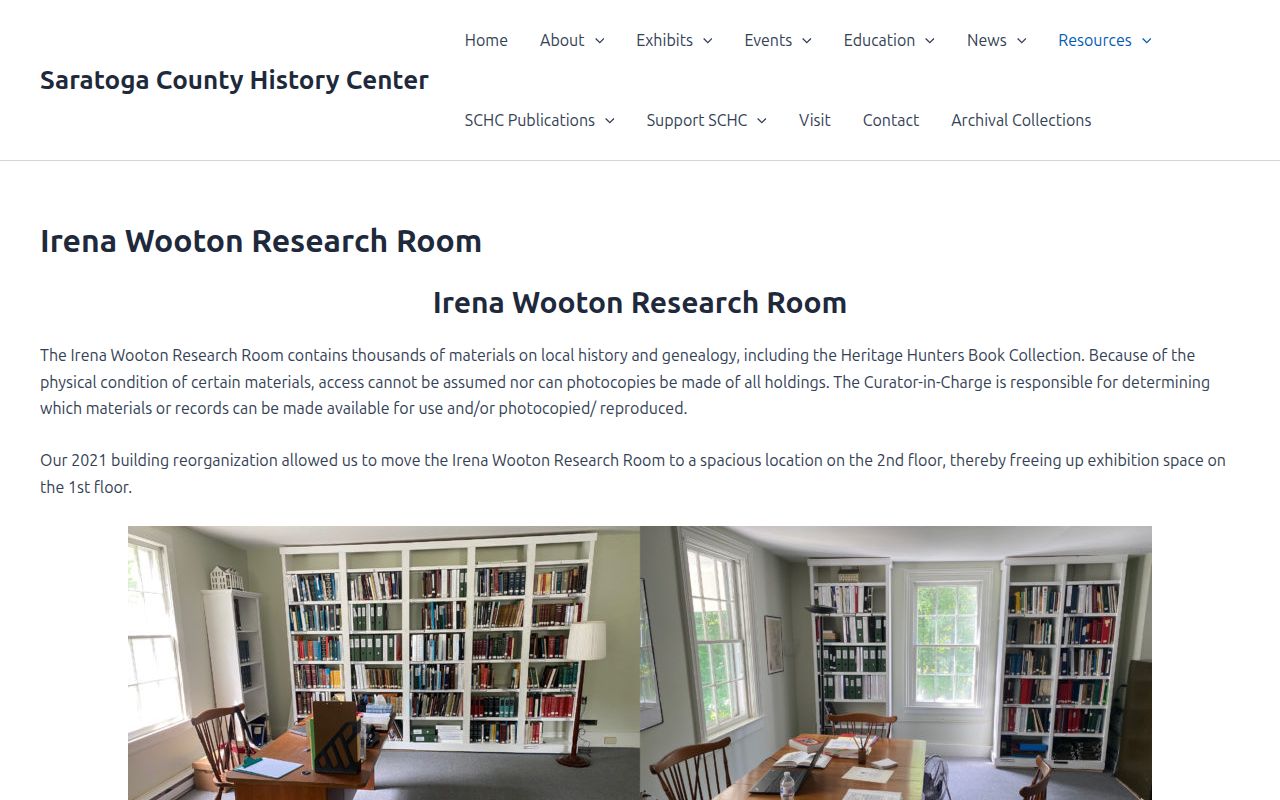
The Brookside image is a practical reminder that the strongest local directory evidence may be in a staffed research room, not in a single public search form.
Halfmoon Historical Collection Access
The Halfmoon Historical Society’s Gerald E. Morris Historical Building is open by appointment. Its inventory identifies town census papers, business records, early vital registers, conveyance lists, mortgages, Justice of the Peace material, assessment papers, school material, and digitized town series. The society is a resource for the town’s records, while the New York State Library is the documented location for the regional city-directory microfilm.
Review the Halfmoon Historical Society collection page before contacting the society, and ask for a series and year range. The Town Clerk has the local administrative route, the library has the local-history room, Brookside has a regional research room, and the state library has the directory shelves. Those separate channels are important fallbacks when an online search produces nothing.
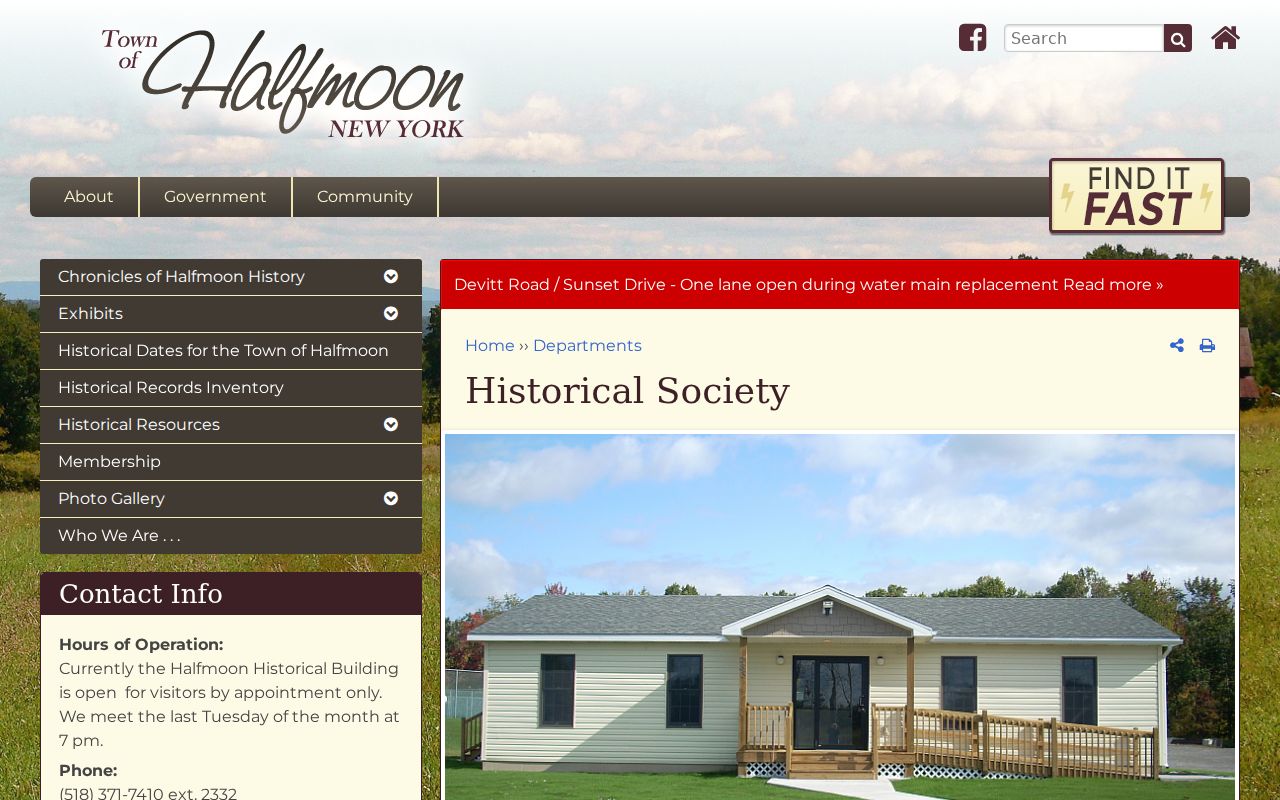
The Historical Society image points to the appointment-based local collection, where a staff request can be tailored to a known surname, street, hamlet, or era.
Use the Town Clerk source to locate the local historical-records gateway.
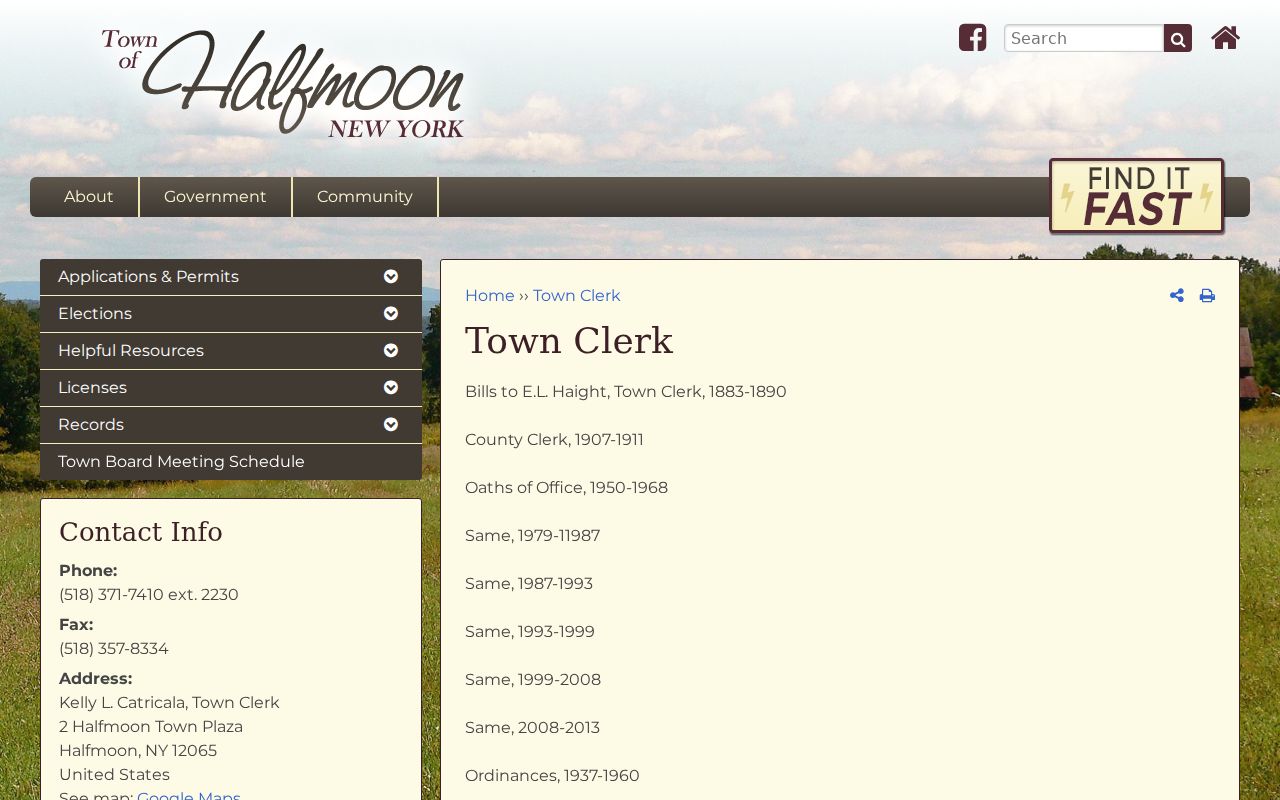
The Town Clerk source complements library research with local register and historical-inventory access rather than a promise of a complete city-directory search.
Check the New York State Library holdings source for the documented microfilm runs.
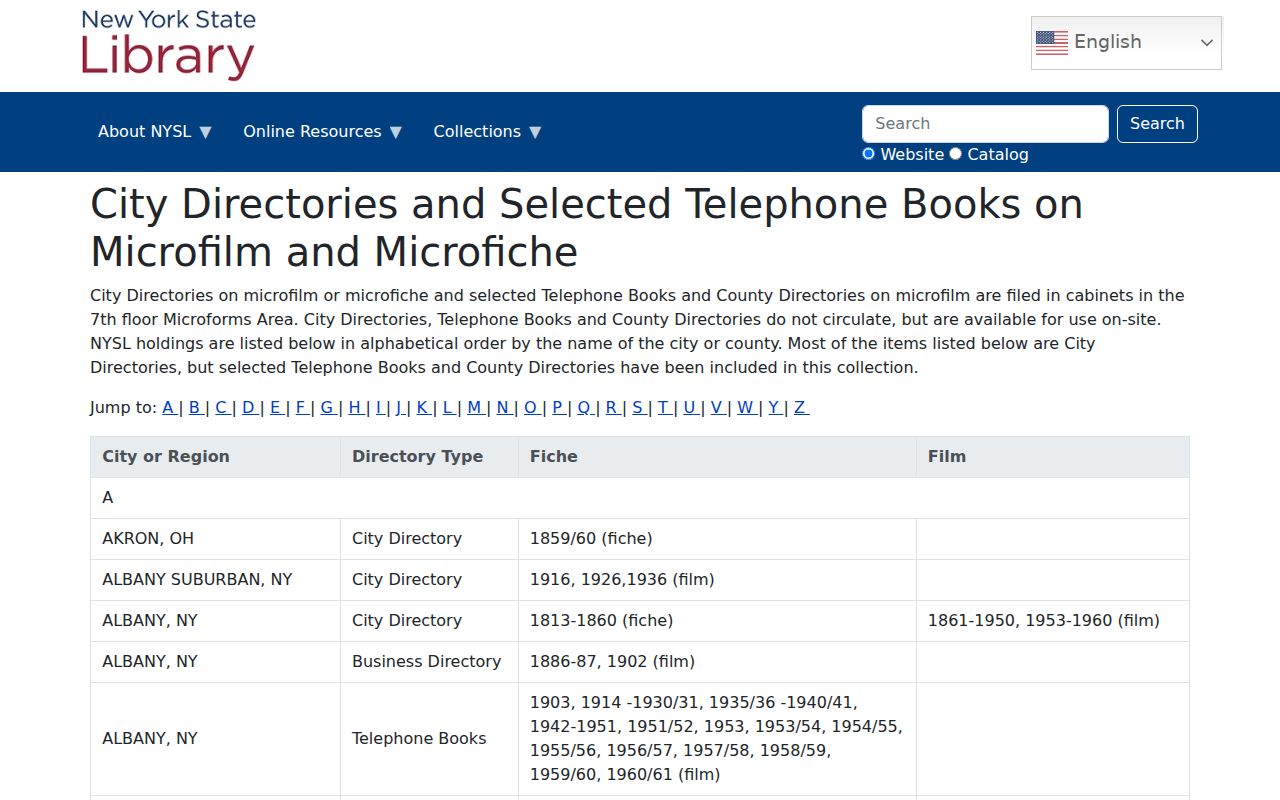
The state-library source is where the documented Saratoga County, Saratoga Springs, and telephone-book holdings can be checked on the actual microfilm.
Open the Clifton Park-Halfmoon Library source before arranging local-history research.
The library source connects a regional directory find to maps, school material, cemetery compilations, and census microfilm kept for local-history work.